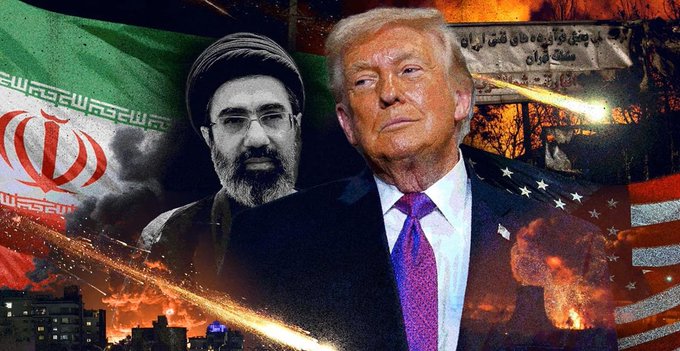
A United States soldier has been killed while another sustained injuries following an Iranian attack in northern Iraq, marking another deadly escalation in the growing conflict between Washington and Tehran.
Titansloaded reports that the incident occurred on Saturday, just one day after an attack in Jordan claimed the lives of two American soldiers and left another service member missing.
According to the United States Central Command (CENTCOM), the soldier was killed during the controlled detonation of unexploded ordnance recovered from a downed Iranian attack drone. A second American service member was injured in the same operation.
CENTCOM also disclosed that search teams recovered unidentified human remains at the site of Friday’s deadly attack in Jordan. The military said forensic examinations are underway to determine the identity of the remains.
The latest casualty comes as the United States and Iran continue exchanging military strikes for an eighth consecutive day, raising fears of a wider regional conflict.
Recent hostilities have seen both nations accuse each other of targeting critical infrastructure. The United States has reimposed its blockade of Iranian ports, while Iran declared the Strait of Hormuz closed and intensified attacks against US allies across the Middle East after a fragile ceasefire collapsed.
The US military said its recent operations were aimed at weakening Iran’s ability to threaten international commercial shipping through the Strait of Hormuz and to retaliate against Iran’s Islamic Revolutionary Guard Corps (IRGC), which Washington blamed for the deadly attack in Jordan.
Verified footage from the Jordanian military facility showed multiple impacts followed by a powerful explosion.
With the latest death, the reported number of American military personnel killed during the conflict has risen to 17 after a US Navy pilot who had been missing earlier this month was officially declared dead.
Iran’s Health Ministry claimed that at least 50 people have been killed and more than 500 injured during US airstrikes carried out over the past three weeks.
Iranian state media also reported that overnight strikes hit an under-construction nuclear power facility in Darkhoveyn in the country’s southwest, as well as Qeshm Island.
The International Atomic Energy Agency (IAEA) urged restraint, noting that the nuclear facility was still in its early stages of construction and did not contain nuclear material during its last inspection.
Meanwhile, Jordan’s state news agency reported that its armed forces intercepted three Iranian missiles, while a fourth landed in an isolated area after the United States warned that the strategic Port of Aqaba could become a target.
Jordan also summoned Iran’s chargé d’affaires in Amman, condemning what it described as “unjustified and blatant Iranian attacks” and insisting that the country’s national security remains a red line.
Israel’s military separately confirmed launching interceptor missiles toward incoming debris after projectiles were fired in the direction of Jordan. It added that fragments later landed near the southern city of Eilat without causing casualties or damage.
The IRGC also claimed that two vessels ignored Iranian warnings against transiting the Strait of Hormuz and were subsequently involved in what it described as “an accident.” It warned that ships associated with the United States and using what it termed unsafe routes could face similar consequences.
In Kuwait, local authorities confirmed that an electricity and water facility struck on Saturday was hit again, triggering a fire.
The Gulf Cooperation Council (GCC), comprising Bahrain, Kuwait, Oman, Qatar, Saudi Arabia and the United Arab Emirates, condemned Iran for allegedly targeting civilian infrastructure, describing the attacks as violations of international law.
Iran, however, accused the United States of attacking bridges, an airport and a railway station earlier in the week. Washington rejected the accusation, insisting its operations had been directed exclusively at military targets and military logistics infrastructure.
The preliminary ceasefire agreement reached after fighting that began on February 28 collapsed less than a month after it took effect, with US President Donald Trump declaring the deal “over” on July 8.
Iran’s Supreme Leader, Mojtaba Khamenei, responded by accusing Washington of repeatedly violating the agreement, stating that the actions of the United States had demonstrated that the American president’s signature “is utterly worthless and devoid of credibility.”