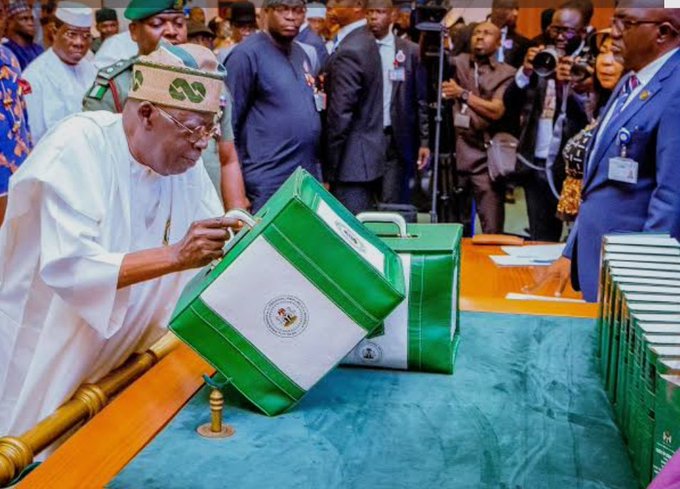
President Bola Ahmed Tinubu has presented the 2026 Appropriation Bill to a joint session of the National Assembly, unveiling a comprehensive fiscal framework aimed at consolidating ongoing economic reforms and strengthening Nigeria’s resilience.
Titansloaded reports that the proposed budget, themed “Budget of Consolidation, Renewed Resilience and Shared Prosperity,” is valued between ₦58.18 trillion and ₦58.47 trillion, reflecting minor variations across official budget documents.

The presentation marks President Tinubu’s third full budget proposal since assuming office in 2023, reinforcing his administration’s commitment to fiscal discipline, economic growth, and improved public service delivery.
The 2026 budget is anchored on the approved 2026–2028 Medium-Term Expenditure Framework (MTEF) and Fiscal Strategy Paper, which outline key macroeconomic assumptions guiding revenue generation and expenditure planning.
According to the proposal, the Federal Government based the budget on an oil benchmark price of $64.85 per barrel, daily oil production of 1.84 million barrels, and an exchange rate of approximately ₦1,512 to one US dollar. The government also projects a GDP growth rate of about 4.68 percent in 2026.
Total projected revenue for the fiscal year stands at ₦34.33 trillion, while the deficit is estimated at ₦23.85 trillion, representing about 4.28 percent of Gross Domestic Product. To finance the deficit, the government plans to raise ₦17.88 trillion through a combination of domestic and external borrowing.
A key policy shift announced in the budget is the plan to end overlapping budget cycles by March 2026. The administration said Nigeria will transition to a single annual budget cycle, with implementation commencing fully in April each year.
On expenditure priorities, ₦26.08 trillion has been allocated to capital expenditure, targeting infrastructure development, MDAs, and multilateral loan-funded projects. Debt servicing accounts for ₦15.52 trillion, including provisions for a sinking fund to manage maturing obligations.
Non-debt recurrent expenditure is projected at ₦15.25 trillion, covering salaries and government operations. Security and defence received ₦5.41 trillion, reflecting the administration’s focus on national stability.
Education and health were allocated ₦3.52 trillion and ₦2.48 trillion, respectively, while infrastructure development will receive ₦3.56 trillion for roads, power, and transport projects nationwide.
The budget will now undergo legislative scrutiny and debate at the National Assembly ahead of possible amendments and passage.
The Federal Government expressed confidence that the 2026 budget will translate economic reforms into job creation, improved living standards, and sustainable growth for Nigerians.